 English

Blog
SMD Components: How Surface Mount Technology Improves Reliability in Intelligent Display Hardware
Intelligent displays combine processing, power management, communication interfaces, memory, touch control, and display electronics within increasingly compact hardware.
The reliability of these systems depends on far more than the LCD panel itself.
Many of the components responsible for powering, protecting, and controlling the display are SMD components mounted directly onto printed circuit boards.
Surface Mount Technology (SMT) allows manufacturers to place smaller electronic components with high precision while reducing the length of electrical connections between them.
For embedded display hardware, these characteristics can support compact PCB layouts, consistent manufacturing, and stable electrical performance.
However, using SMD components alone does not guarantee reliability.
Component quality, PCB design, thermal management, soldering processes, inspection, and supplier controls all influence whether an intelligent display continues operating reliably throughout its intended service life. Keep reading to understand better!
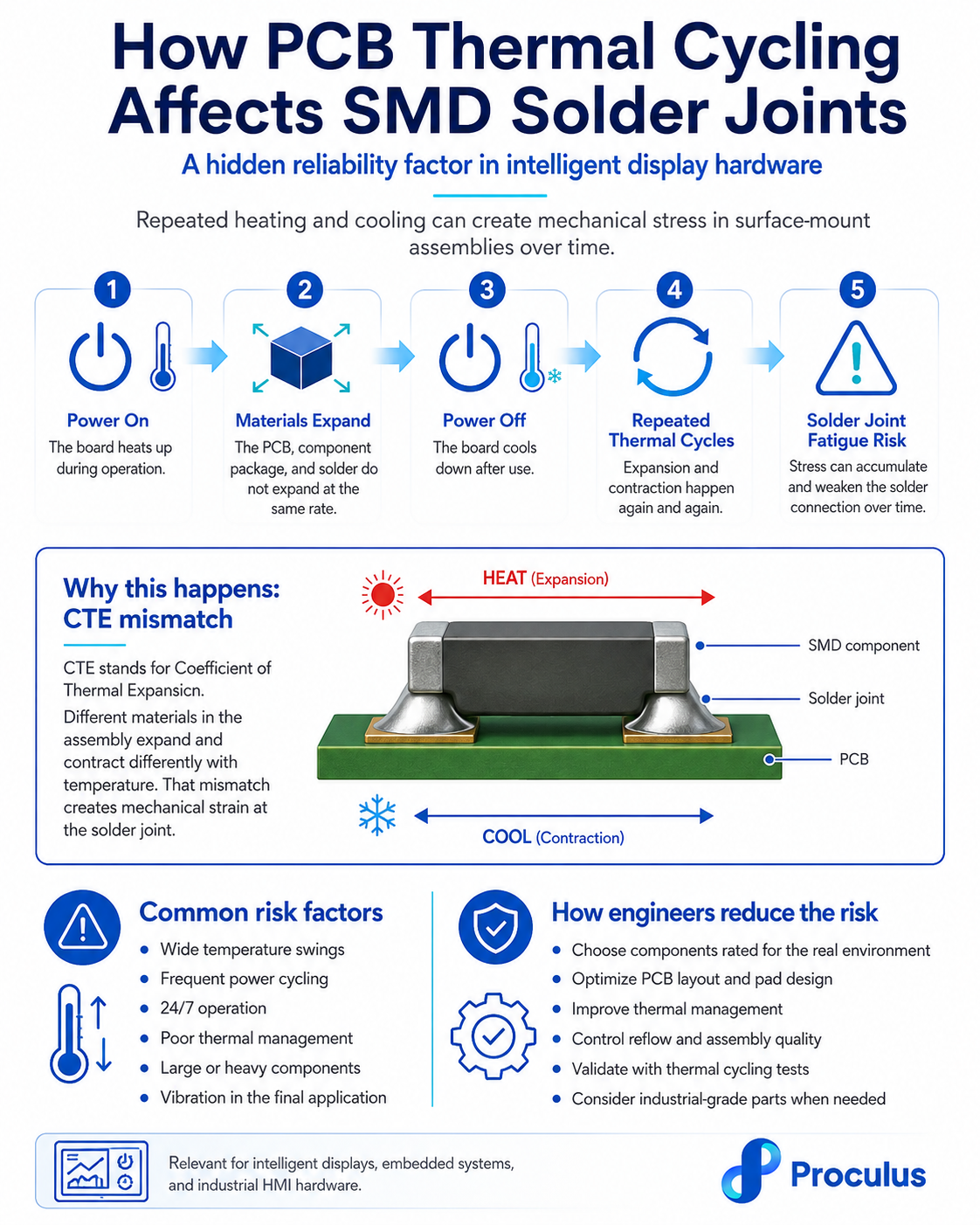
Why do SMD components matter in modern intelligent display design?
SMD components are designed to be mounted directly onto the surface of a printed circuit board rather than inserted through drilled holes. Their small footprint allows engineers to place more functionality within limited PCB space. This matters in intelligent displays because the control board may need to accommodate a processor, memory, communication circuits, voltage regulators, protection devices, touch controllers, and numerous passive components behind a relatively thin display assembly. Shorter electrical paths can also help engineers control parasitic inductance and capacitance. That becomes increasingly important around high-speed digital interfaces, switching power supplies, memory buses, and other circuits where PCB layout affects signal and power integrity. Automated SMT production also supports repeatable component placement across large manufacturing runs. When combined with controlled solder paste deposition, reflow profiles, and inspection, this process helps manufacturers maintain consistent assemblies from prototype development through volume production. For engineering teams looking for display platforms that integrate processing, communication, and interface hardware into ready-to-develop modules, explore the intelligent display solutions available from Proculus!How do SMD components improve hardware reliability?
One advantage of SMD components is their low physical mass. Smaller components experience less mechanical force from vibration and acceleration than heavier parts mounted above the PCB surface. This can be useful in industrial equipment, mobile machinery, and other systems exposed to continuous movement. SMT also allows components to sit close to the PCB, producing short interconnections between devices. Shorter traces can improve electrical behavior by reducing unwanted resistance, inductance, and susceptibility to interference when the PCB is designed correctly. Manufacturing consistency is another important factor. Automated pick-and-place equipment can position thousands of components with repeatable accuracy. Controlled reflow soldering then forms connections across the board within a defined thermal process. Reliability still depends on correct engineering decisions. Poor pad geometry, inappropriate solder paste volume, insufficient thermal design, excessive component stress, or an unsuitable reflow profile can create failures even when high-quality components are used. SMT should therefore be understood as part of a complete reliability strategy rather than a substitute for good hardware engineering.Which SMD components are critical inside an intelligent display?
An intelligent display PCB may contain hundreds or thousands of individual SMD devices. Several component groups have particularly important roles. Resistors establish voltage levels, limit current, terminate signal lines, and configure integrated circuits. Their values and tolerances can directly influence analog measurements, communication circuits, and power systems. Multilayer ceramic capacitors (MLCCs) are widely used for decoupling, filtering, and energy storage. Decoupling capacitors placed close to processors and other integrated circuits help stabilize local supply voltage during rapid changes in current demand. Inductors are commonly found in switching power converters and filtering circuits. Their current rating, saturation characteristics, and thermal behavior affect power-system stability. MOSFETs and diodes handle switching and protection functions. They may control power rails, protect circuits from reverse polarity, or support DC-DC converter operation. Voltage regulators and power-management ICs convert incoming power into the voltage rails required by processors, memory, interface circuits, and backlight systems. ESD and transient-protection devices help protect communication ports and exposed interfaces against electrostatic discharge and electrical transients. Processors, memory devices, interface controllers, and touch controllers are also commonly supplied in surface-mount packages. Their electrical and thermal requirements often determine much of the PCB architecture around them. The importance of each component therefore depends on its function within the complete system.When should engineers choose industrial-grade SMD components?
Industrial-grade components become particularly important when equipment operates outside controlled indoor environments. Applications exposed to high or low temperatures need components rated for the expected operating range. Equipment installed near motors or heavy machinery may also require greater resistance to vibration and electrical noise. Continuous-duty systems create another requirement. A display that operates eight, sixteen, or twenty-four hours per day accumulates thermal and electrical stress much faster than a device used occasionally. Engineers should also consider industrial-grade components when hardware is difficult or expensive to access after installation. A slightly higher component cost may be justified when replacing the finished equipment would require shutting down machinery or dispatching service personnel. Other factors include:- wide input-voltage ranges;
- high ambient temperatures;
- frequent power cycling;
- electrical transients;
- vibration;
- extended product lifecycles;
- limited opportunities for field maintenance.
Frequently Asked Questions about SMD Components
How do SMD components improve the reliability of intelligent displays?
SMD components can support reliable intelligent display hardware through compact placement, short electrical connections, low component mass, and repeatable automated assembly. Their reliability still depends on correct component selection, PCB layout, soldering, thermal management, and manufacturing quality.Which SMD components are most critical in embedded display systems?
Important SMD components include power-management ICs, capacitors, resistors, inductors, processors, memory devices, MOSFETs, protection devices, interface controllers, and touch controllers. The most critical devices vary according to the architecture of the display and the functions performed by its control board.How can engineers identify high-quality SMT manufacturing?
Engineers should look for controlled component sourcing, automated placement, documented reflow processes, PCB inspection, electrical testing, functional validation, and consistent quality-control procedures. Supplier transparency and access to technical documentation are also valuable indicators.What should OEMs consider when evaluating hardware suppliers?
OEMs should consider product architecture, component quality, manufacturing controls, documentation, customization capabilities, engineering support, supply continuity, and the supplier’s ability to support production at the required scale. The evaluation should account for the complete product lifecycle rather than unit price alone.Build More Reliable Intelligent Display Hardware with Proculus Tech!
Reliable intelligent displays are created through a combination of sound component selection, disciplined PCB design, controlled manufacturing, and an architecture suited to the final application. For engineering teams, the practical objective is to reduce the amount of hardware complexity that must be developed and validated internally. Proculus provides intelligent display solutions designed for embedded and HMI applications, including platforms that integrate display hardware with processing, communication, and GUI development capabilities. These modules can help development teams move from interface design and prototyping toward production without building every part of the display subsystem from scratch. Explore the Proculus intelligent display product range to find a platform that fits the hardware, interface, and development requirements of your next embedded project!

PHP Code Snippets Powered By : XYZScripts.com