 English

Blog
What is an embedded system? Characteristics, applications and challenges
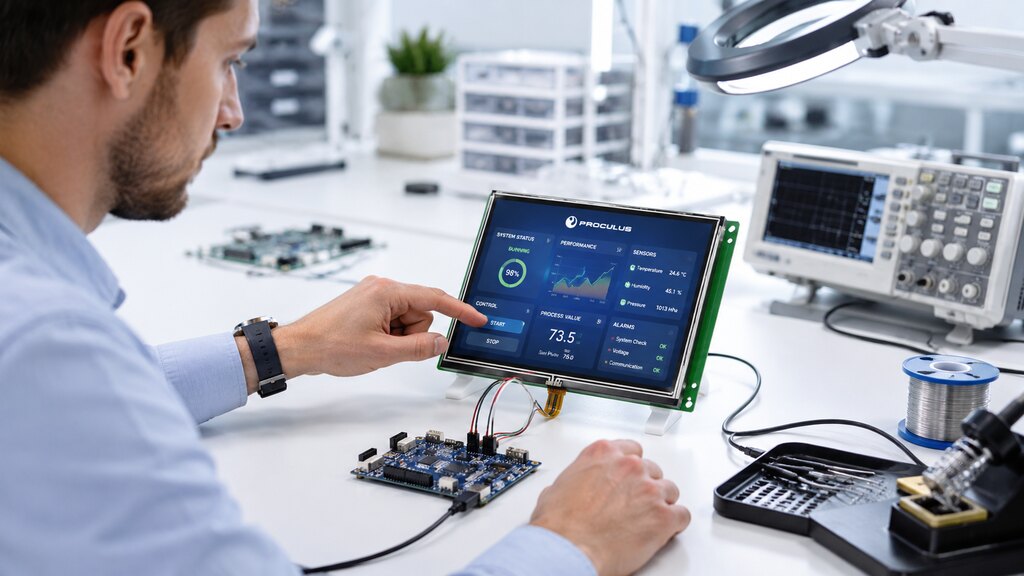 Embedded systems are at the core of modern electronic products. They control machines, process data, connect devices, monitor conditions and support user interfaces in products that must work reliably every day.
From industrial machinery and medical equipment to automobiles and smart home devices, embedded systems are designed to perform specific tasks inside a larger product.
Understanding how they work helps engineering teams make better decisions about hardware, software, connectivity and display integration.
Embedded systems are at the core of modern electronic products. They control machines, process data, connect devices, monitor conditions and support user interfaces in products that must work reliably every day.
From industrial machinery and medical equipment to automobiles and smart home devices, embedded systems are designed to perform specific tasks inside a larger product.
Understanding how they work helps engineering teams make better decisions about hardware, software, connectivity and display integration.
What is an embedded system?
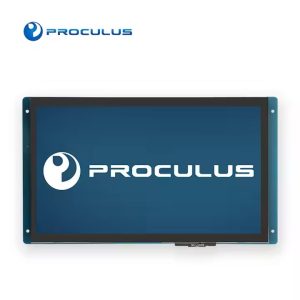
An embedded system is a dedicated computing system built into a device, machine or product to perform one or more specific functions. Unlike a general-purpose computer, such as a laptop or desktop PC, an embedded system is usually designed for a defined task. It may control a motor, read sensor data, manage a user interface, process communication signals or automate a machine function. Most embedded systems combine hardware and software. The hardware may include a microcontroller, microprocessor, memory, sensors, actuators, communication interfaces and display modules. The software, often called firmware, defines how the system responds to inputs, controls outputs and communicates with other components. Embedded systems can be simple or complex. A basic thermostat, for example, may use a small microcontroller and a simple display. A medical imaging device or industrial automation controller may include multiple processors, advanced software, touchscreen interfaces and real-time communication protocols. For engineering teams, the key value of an embedded system is control. It allows a product to perform its intended function consistently, efficiently and often with limited power, space and processing resources. Build a smarter touchscreen interface for your embedded product with Proculus UART TFT LCD modules. Explore the solution here!How embedded systems work?
An embedded system works by receiving input, processing that input according to programmed instructions and generating an output. The input may come from sensors, buttons, touchscreens, communication ports or connected systems. The processing is handled by a microcontroller, microprocessor, digital signal processor or system-on-chip. The output may control a motor, activate an alarm, update a display, send data to another device or adjust system behavior. In many products, embedded systems must operate continuously and predictably. Some are real-time systems, which means they must respond within strict timing limits. For example, an automotive braking system cannot delay its response, and a patient monitoring device must process critical data with high reliability. Embedded systems also often work under constraints. They may have limited memory, limited processing power, strict energy requirements, compact board space or demanding environmental conditions. This is why embedded design requires careful planning across hardware, firmware, interface design and production requirements.Characteristics of embedded systems
Embedded systems usually share several important characteristics:- Task-specific operation: They are designed to perform a defined function or set of functions.
- Hardware and software integration: The system depends on close coordination between electronics and firmware.
- Reliability: Many embedded products must operate for long periods without failure.
- Efficiency: They are often optimized for low power consumption, compact size and cost-effective production.
- Real-time performance: Some systems must respond within precise timing requirements.
- Limited resources: Memory, processing power and interface options may be constrained.
- Long product lifecycles: Industrial, medical and automotive systems often need stable components and long-term support.
- Environmental resistance: Some embedded devices must work in high or low temperatures, vibration, humidity or electrically noisy environments.
Structure of embedded systems
The structure of an embedded system depends on the product, but most systems include four main layers. The first layer is the hardware platform. This includes the microcontroller or processor, memory, power supply, PCB, communication interfaces and peripheral components. The second layer is the input and output layer. Inputs may include sensors, switches, keypads, encoders, cameras or touchscreens. Outputs may include displays, motors, relays, LEDs, buzzers, valves or communication signals. The third layer is the firmware or embedded software. This software controls how the system behaves. It may include device drivers, communication protocols, control logic, user interface logic and data processing routines. The fourth layer is the user interface or connectivity layer. In many modern products, users need to interact with the system through a display, touchscreen, mobile app, cloud platform or control panel. This layer is especially important for industrial equipment, medical devices, smart appliances and automation systems. A well-designed embedded system connects these layers efficiently. The hardware must support the application, the firmware must be stable and maintainable, and the interface must make the product easy to operate.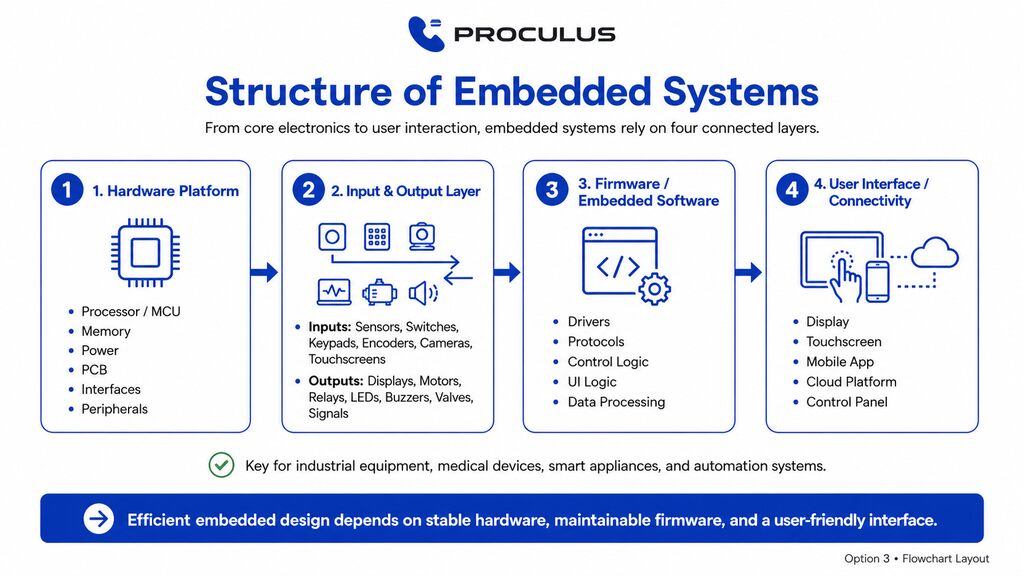
Types of embedded systems
Embedded systems can be classified in different ways depending on their performance, connectivity and application requirements. One common classification includes standalone systems, real-time systems, networked systems and mobile embedded systems. Each type has different design priorities, from low power consumption to fast response time, remote communication or compact integration. Standalone embedded systems operate independently. They receive input, process it and generate output without needing a host computer. Examples include washing machines, digital thermometers and basic control panels. Real-time embedded systems must respond within specific time limits. These systems are common in automotive control, industrial automation, robotics and medical monitoring. In these applications, delayed responses can affect safety, performance or product quality. Networked embedded systems communicate with other devices or platforms through wired or wireless networks. They are widely used in smart home devices, industrial IoT, energy management systems and remote monitoring equipment. Mobile embedded systems are compact, portable and usually optimized for battery operation. Examples include smartphones, wearable devices, handheld scanners and portable medical devices. For product teams, choosing the right embedded architecture depends on the required function, processing load, power budget, connectivity, user interface and production environment.Examples of embedded system applications
Embedded systems are used across industries because they provide dedicated control inside products and machines. Common applications include:- Automobiles: Embedded systems control engine management, braking systems, airbags, infotainment, climate control, battery management and advanced driver assistance features. Modern vehicles may contain dozens of embedded controllers working together.
- Mobile phones: Smartphones use embedded systems to manage touch input, cameras, sensors, wireless communication, battery charging, audio, display control and security functions.
- Industrial machinery: Embedded controllers are used in factory automation, motor control, programmable logic systems, human-machine interfaces, temperature control, production monitoring and safety systems.
- Medical equipment: Embedded systems support patient monitors, diagnostic devices, infusion pumps, imaging equipment, portable test devices and touchscreen control panels. In this field, reliability, usability and stable performance are critical.
Challenges in embedded system design
Embedded system design requires balancing performance, cost, reliability and usability. One of the main challenges is working with limited resources. A microcontroller may have restricted memory, processing power and interface capacity, so every design decision matters. Another challenge is hardware and software integration. Firmware must match the selected components, communication interfaces and electrical design. Even a small mismatch between hardware requirements and software logic can create delays during prototyping or production. Reliability is also a major concern. Embedded systems may run continuously for years. In industrial, medical or automotive applications, failures can be expensive or dangerous. Engineers must consider component quality, firmware stability, thermal behavior, electromagnetic interference and long-term availability. User interface design is another frequent challenge. Many embedded products need a display or touchscreen, but building a graphical interface from scratch can require significant development time. Teams must decide how the interface will be designed, how it will communicate with the controller and how updates will be managed. Scalability is also important. A prototype may work well in the lab, but production introduces new requirements: repeatability, supply stability, documentation, testing, certifications, enclosure design and support. The best embedded designs solve these challenges early. Teams should define the application requirements, interface needs, communication protocols, environmental conditions and production goals before selecting core components.How to approach display in embedded systems
The display is often the part of an embedded product that users interact with most directly. It must be clear, responsive, reliable and easy to integrate. For simple products, a basic character display or LED indicator may be enough. For more advanced equipment, a TFT LCD with a graphical user interface can improve usability, reduce training time and make the product feel more professional. When selecting a display for an embedded system, engineering teams should consider several factors:- Screen size and resolution
- Touch type, such as resistive or capacitive
- Communication interface, such as UART, RS232, RS485 or TTL
- Operating temperature range
- Power requirements
- GUI development workflow
- Mounting and enclosure requirements
- Long-term availability
- Technical support and documentation
FAQ: What is an embedded system?
What is the definition of an embedded system?
An embedded system is a dedicated computer system built into a larger device or machine to perform a specific function. It usually combines hardware, firmware and input/output components to control a product, process data or manage communication.What are examples of an embedded system?
Examples of embedded systems include automotive control units, smart thermostats, medical monitors, industrial controllers, washing machines, smartphones, security systems, vending machines and touchscreen HMIs used in equipment control panels.What are the 4 types of embedded systems?
The four common types of embedded systems are standalone embedded systems, real-time embedded systems, networked embedded systems and mobile embedded systems. Each type is designed for different requirements, such as independent operation, fast response, connectivity or portability.Will AI replace embedded systems?
AI will not replace embedded systems. Instead, AI will increasingly run inside embedded systems or connect to them. Many future devices will combine embedded control with AI features such as predictive maintenance, image recognition, voice control, anomaly detection and smarter automation. The embedded system will still be needed to manage hardware, process inputs, control outputs and keep the product operating reliably.

PHP Code Snippets Powered By : XYZScripts.com